
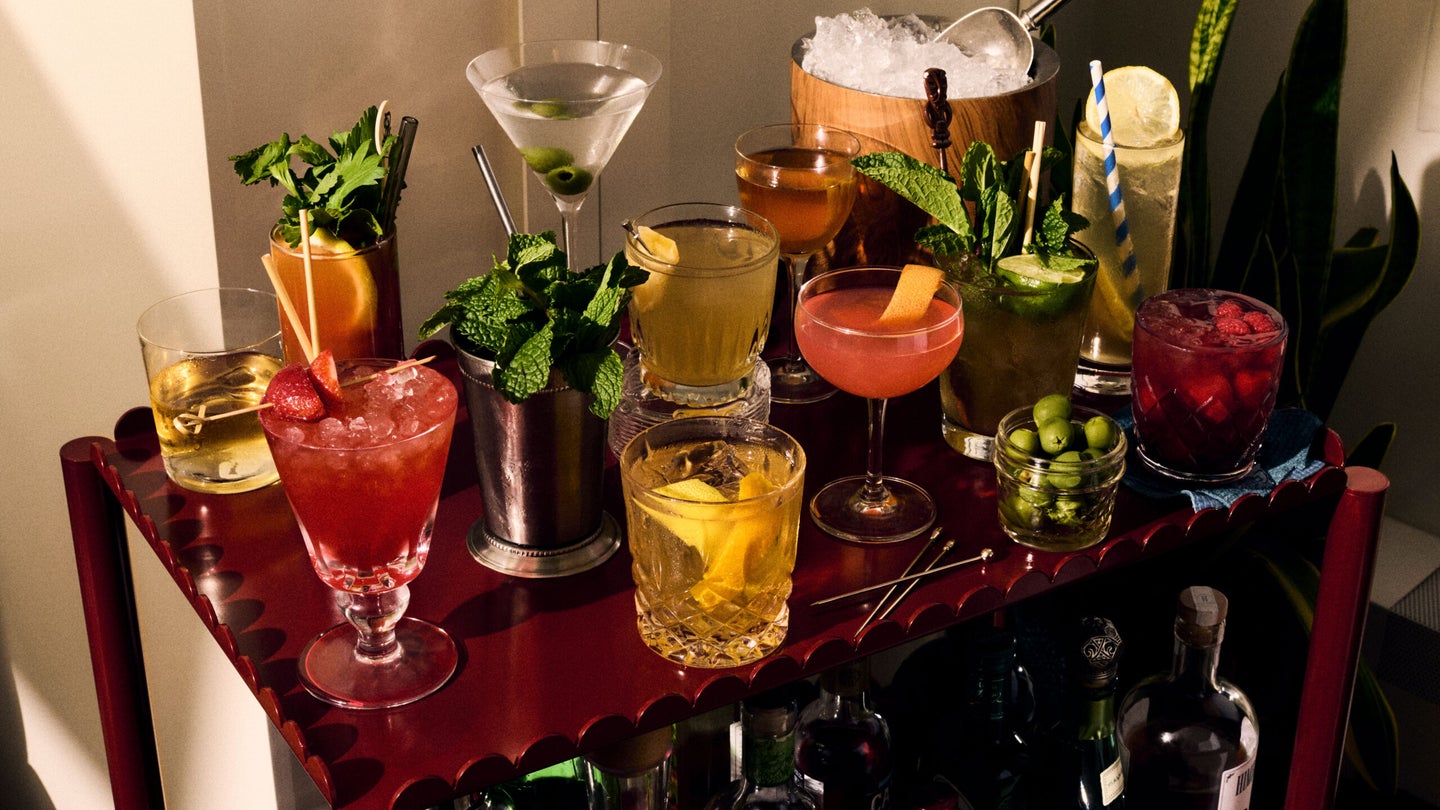

As the United States marks 250 years this July, its beverage history offers another way to read the country: through ingredients, labor, migration, trade, regional taste, and ritual. American drinks were never shaped by one tradition alone: They emerged from farm fields and hotel bars, taverns and racetracks, Caribbean trade routes and Southern cookouts, immigrant neighborhoods and modern cocktail dens.
The drinks gathered here are cultural documents as much as recipes. Some predate the very concept of the cocktail itself. Some helped define it. Some are alcoholic, while some are not. Together, they trace a broad arc of American beverage culture: from colonial refreshers and punch bowls to the rise of the mixed drink, the hotel bar, brunch, tiki, modern classic cocktails, and contemporary conversations about what belongs in the canon.
To celebrate America’s landmark semiquincentennial, here are 12 iconic drinks that helped transform the country’s beverage culture into the diverse and wide-reaching phenomenon it is today.
Switchel

Switchel is essentially a precursor to Gatorade: a field worker’s solution to staying hydrated while laboring under the heat of the sun. Made with apple cider vinegar, ginger, molasses, and water, it is tart, bracing, mineral, and deeply refreshing. Also known as a haymaker’s punch, it belongs to an early colonial American world of farm drinks, orchard cider, practical refreshment, and working-day hospitality.
Switchel stands on its own as a nonalcoholic refresher, but it can also be built into a simple highball with rum, rye whiskey, or apple brandy. Applejack is especially fitting, as it connects the drink to the orchard economy that shaped early American cider and apple spirits. With that addition, the drink is tart, gingery, lightly sweet, and bright enough for hot weather. Get the recipe >
Milk Punch

Long before clarified cocktails returned to modern bar programs, milk punch solved a practical problem: how to make a punch that could keep on a shelf and travel. Milk, sugar, citrus, spirit, and spice were combined and allowed to curdle, then strained until the liquid became clear, delicate, and stable. David Wondrich and Noah Rothbaum, in The Oxford Companion to Spirits and Cocktails, place milk punch in a broader family of British dairy-based drinks that includes posset and syllabub.
This version is built on Benjamin Franklin’s 1763 recipe, a brandy-based punch associated with Philadelphia and the early Republic. Its ingredients tell a larger story: French brandy, West Indian citrus, English country-house technique, and American hospitality. Milk punch captures the young country’s relationship to the wider Atlantic world—cosmopolitan, practical, and eager to translate borrowed forms into something of its own. Get the recipe >
Sazerac

Few cities have given the United States as many enduring cocktails as New Orleans, and few drinks carry a city’s identity as powerfully as the Sazerac. First served in the 19th century—originally with cognac, before rye whiskey became standard—the Sazerac reflects New Orleans’ position as a crossroads of French, Caribbean, American, and Creole influence.
The drink’s defining move, an absinthe rinse that coats the glass and is then discarded, is an architectural lesson in restraint. The absinthe is not simply an ingredient; it is an aromatic frame. In New Orleans, the Sazerac remains both a civic emblem and a living ritual, served in hotel bars, neighborhood cocktail institutions, and historic rooms throughout the city. Get the recipe >
Old-Fashioned

When “cocktail” first entered the American vocabulary, the old-fashioned represented the clearest expression of the word. An often-cited 1806 newspaper definition described a cocktail as “a stimulating mixture of spirits, sugar, water, and bitters.” That, by definition, is the old-fashioned.
The name tells the story. By the late 19th century, American bars were producing increasingly elaborate drinks. To ask for one “in the old-fashioned way” was to ask for something simpler. Made with bourbon, rye, or brandy—the Wisconsin supper-club tradition has long preferred the latter—the drink is a compact lesson in balance. Spirit, sugar, water, bitters, and citrus peel: The formula is spare, but it remains one of the essential structures of American drinking. Get the recipe >
Martinez

The Martinez sits at a critical point in the evolution of the American cocktail. Made with Old Tom gin, sweet vermouth, maraschino liqueur, and bitters, it appears somewhere between the Manhattan and the martini. As Derek Brown traces in Spirits, Sugar, Water, Bitters, the Martinez is one of the missing links in the development of the modern bar.
Its ingredients reveal a different palate from the dry, austere drinks many people now associate with gin. Old Tom is rounder and lightly sweetened. Sweet vermouth carries weight. Maraschino liqueur adds perfume, texture, and faint bitterness. The Martinez shows how American cocktails moved from sweetened, aromatic, wine-influenced formulas toward the sharper, drier forms that would come to dominate the 20th century. Get the recipe >
Martini

The martini occupies an iconic place in the American imagination, thanks in no small part to literature, cinema, and the mythology of elegance. Beneath that mythology is a precise and revealing drink: gin, vermouth, water, temperature, and garnish.
Its evolution tells the story of changing American taste. Early martinis were wetter, softer, and more vermouth-driven. Over time, the drink became drier, colder, and more spirit-forward, reflecting a 20th-century preference for clarity and austerity. Made 50/50—equal parts gin and vermouth—it becomes rounder and more sessionable. Made dry, with less vermouth, it becomes bracing and architectural. Few cocktails demonstrate the power of proportion more clearly. Get the recipe >
Bloody Mary

The Bloody Mary is most often traced to Fernand Petiot, the French bartender at Harry’s New York Bar in Paris, who is said to have combined vodka with canned tomato juice in the 1920s. He later refined the drink at New York’s St. Regis Hotel, where it appeared under the more genteel name Red Snapper.
Today, the Bloody Mary remains the quintessential brunch cocktail: savory, spicy, bracing, and endlessly adaptable. It belongs to a long tradition of restorative beverages meant to revive, steady, or prepare the drinker for the day ahead. It also reflects the American appetite for customization. Gin turns it toward the Red Snapper; tequila makes it a Bloody Maria. Pickles, hot sauce, celery salt, horseradish, citrus, brines, and tomato preparations allow the drink to absorb regional taste while remaining unmistakably itself. Get the recipe >
Mint Julep

The mint julep does not begin with a recipe so much as a hospitality gesture. Some of the most evocative early descriptions read less like formulas than instructions passed from one person to another: how to handle mint, how to build ice, how to present the cup. Derek Brown places the julep alongside the old-fashioned, Sazerac, and sherry cobbler as one of the drinks that helped define the American bar.
When the julep became popular, ice and sugar still carried a sense of luxury. Part of the drink’s pleasure was spectacle: a metal cup frosted with crushed ice, a bouquet of mint, the aroma of the leaves announcing the drink before the first sip. Today, the julep is best known as the signature cocktail of the Kentucky Derby, but its history also points to the skill of Black bartenders and hospitality workers who helped perfect 19th-century American drinking culture, including Tom Bullock, author of 1917’s The Ideal Bartender. Get the recipe >
Mai Tai

The mai tai is one of the great tiki classics: simple on paper, endlessly debated in practice. Trader Vic is widely credited with creating the version that became canonical, built around a now-legendary bottle of Wray & Nephew 17-year-aged Jamaican rum. When that rum disappeared from the market, Vic began creating proprietary blends to preserve the flavor and structure of the original drink.
The mai tai advances the American beverage story by showing how rum, Caribbean ingredients, fantasy, branding, and mid-century hospitality converged in tiki. At its best, it is not a drink of excess but of precision: rum, lime, curaçao, orgeat, and balance. A great mai tai depends on choosing the right rums and letting them speak. Get the recipe >
Red Drink

Red drinks have long held a celebratory place at American tables, particularly across the South and the African diaspora. The tradition reaches through West African bissap, Caribbean sorrel, Mexican agua de Jamaica, and the deep-red coolers poured at cookouts, church gatherings, family reunions, and Juneteenth celebrations. In that sense, “red drink” is not a single recipe so much as a cultural throughline—a way of carrying memory, hospitality, and celebration in the glass.
This original take, called Homecoming, steps slightly to the side of the canonical hibiscus base and works instead with ripe strawberries and raspberries. The shift keeps the drink within the broader red drink tradition while rooting it in summer fruit. The cordial does the heavy lifting: fresh berry flavor, lemon for brightness, sugar for body, and salt for structure. A chilled black tea base gives the drink a Southern sweet-tea backbone; served over ice, Homecoming is both festive and refreshing. With the addition of rum, gin, vodka, or bourbon, it moves easily from family table to cocktail hour. Get the recipe >
Penicillin

Created by Sam Ross at Milk & Honey in New York in the mid-2000s, the Penicillin represents the modern classic era of American cocktails. It takes the architecture of a Whiskey Sour—spirit, citrus, sweetener—and gives it new dimension through scotch, ginger, honey, and smoke.
The drink’s defining move is structural: blended scotch in the body, with a small float of smoky single malt on top. That technique has influenced countless contemporary cocktails, proving how a simple adjustment in layering can change aroma, texture, and perception. The Penicillin reads as restorative in cold weather and refreshing in warm weather, and approachable enough to introduce drinkers to scotch without overwhelming them. Get the recipe >
Siesta

Created by Katie Stipe at New York’s Flatiron Lounge in 2006, the Siesta belongs to the modern classic movement that reshaped American cocktail bars in the early 21st century. As Robert Simonson documents in Modern Classic Cocktails, the drink moved tequila beyond the margarita template and placed it in conversation with aperitivo culture.
The recipe—tequila, Campari, lime, grapefruit, and simple syrup—draws on several structures at once: the snap of a daiquiri, the citrus-and-agave frame of a margarita, and the bittersweet undertow that would later define drinks like the Paper Plane. Its success lies in balance. The Siesta is vivid, refreshing, and lightly bitter, a drink that feels accessible to casual drinkers and compelling to bartenders. In that way, it captures one of the central achievements of the modern American cocktail revival. Get the recipe >
.saveur-newsletter-embed {
–saveur-tomato: #e9552d;
–saveur-peach: #f5be8f;
–saveur-flour: #f7f4ec;
–saveur-kale: #29483d;
–saveur-rule: #a9a9a9;
background: #fff;
color: #000;
font-family: “Source Serif Pro”, Georgia, “Times New Roman”, serif;
width: 100%;
max-width: none;
margin: 34px 0;
padding: 28px 0 30px;
border-top: 2px dotted var(–saveur-rule);
border-bottom: 2px dotted var(–saveur-rule);
text-align: center;
line-height: 1.4;
}
.saveur-newsletter-embed__title {
margin: 0 0 16px;
color: var(–saveur-tomato);
font-family: Louize, “EB Garamond”, Georgia, serif;
font-size: clamp(2rem, 4vw, 2.7rem);
font-weight: 400;
line-height: 0.98;
letter-spacing: -0.01em;
}
.saveur-newsletter-embed__message {
max-width: 38rem;
margin: 0 auto 22px;
font-size: 1.08rem;
line-height: 1.55;
text-align: center;
color: #6b6b6b;
font-style: italic;
}
.saveur-newsletter-row {
display: flex;
gap: 10px;
align-items: stretch;
justify-content: center;
max-width: 38rem;
margin: 0 auto;
}
.saveur-newsletter-row input(type=”email”) {
flex: 1 1 auto;
min-width: 0;
padding: 14px 16px;
font-family: “Source Serif Pro”, Georgia, “Times New Roman”, serif;
font-size: 1.05rem;
line-height: 1.2;
border: 1px solid #000;
border-radius: 0;
-webkit-appearance: none;
appearance: none;
background: var(–saveur-flour);
color: #000;
box-sizing: border-box;
transition: border-color 0.2s ease, box-shadow 0.2s ease, background-color 0.2s ease;
}
.saveur-newsletter-row input(type=”email”)::placeholder {
color: #7b7b7b;
}
.saveur-newsletter-row input(type=”email”):focus {
outline: none;
border-color: var(–saveur-tomato);
background: #fff;
box-shadow: 0 0 0 2px rgba(233, 85, 45, 0.14);
}
.saveur-newsletter-row input(type=”email”).is-success {
border-color: var(–saveur-kale);
background: #fff;
color: var(–saveur-kale);
box-shadow: 0 0 0 2px rgba(41, 72, 61, 0.14);
}
.saveur-newsletter-row input(type=”email”).is-success::placeholder {
color: var(–saveur-kale);
opacity: 1;
}
.saveur-newsletter-row button {
flex: 0 0 auto;
min-height: 54px;
padding: 14px 22px;
border: 1px solid var(–saveur-tomato);
border-radius: 0 !important;
-webkit-appearance: none;
appearance: none;
background: var(–saveur-tomato);
color: #fff;
font-family: “Roboto Mono”, “SFMono-Regular”, Menlo, Consolas, monospace;
font-size: 0.84rem;
font-weight: 400;
letter-spacing: 0.12em;
line-height: 1;
text-transform: uppercase;
cursor: pointer;
white-space: nowrap;
transition: background-color 0.2s ease, border-color 0.2s ease, color 0.2s ease;
}
.saveur-newsletter-row button:hover,
.saveur-newsletter-row button:focus {
background: #000;
border-color: #000;
color: #fff;
}
.saveur-newsletter-row button:disabled {
opacity: 0.85;
cursor: wait;
}
.saveur-newsletter-embed .response {
max-width: 38rem;
margin: 12px auto 0;
font-size: 0.97rem;
line-height: 1.45;
text-align: center;
}
.saveur-newsletter-embed .response(hidden) {
display: none !important;
}
.saveur-newsletter-embed .response.success {
color: var(–saveur-kale);
}
.saveur-newsletter-embed .response.error {
color: var(–saveur-tomato);
}
@media (max-width: 560px) {
.saveur-newsletter-embed {
margin: 28px auto;
padding: 24px 0 26px;
}
.saveur-newsletter-embed__title {
font-size: 2rem;
}
.saveur-newsletter-embed__message {
font-size: 1rem;
margin-bottom: 18px;
}
.saveur-newsletter-row {
flex-direction: column;
gap: 8px;
}
.saveur-newsletter-row button {
width: 100%;
justify-content: center;
}
}
The post 12 Essential Drinks That Offer a Sip of American History appeared first on Saveur.
