
There is no shelter or pretense on the west coast of Ireland. The land is bare and unadorned, its raving-mad beauty indifferent. Wind tears through stone and pasture. The light shifts without warning—now pewter, now gold—and the sea keeps redrawing the lines. Sheep nibble at the hills and lakes mirror the sky; cliffs and cottages blur in the mist. Even the air has flavor: sweet clover, peat smoke, and brine. Indoors, add wet wool and bitter stout.
It’s hard to imagine a place so enchanting as one of exile. Yet here, along the Atlantic, in Connemara’s rocky fields and the Burren’s limestone moonscapes, the Irish were sent to die. Banished by the British under 16th-century penal laws, they survived on sheer grit on unforgiving terrain for generations. When the Great Famine struck in the mid-1800s, families perished or boarded ships, leaving land and memory behind. Those who stayed learned to bend with the wind, feeding on persistence and wit. They fished unpatrolled inlets in canvas currachs, cut peat bogs for fuel, and saved what seeds they could. Traces of those years still mark the land—roofless cottages and dead-end roads built by the starving for a day’s bread.
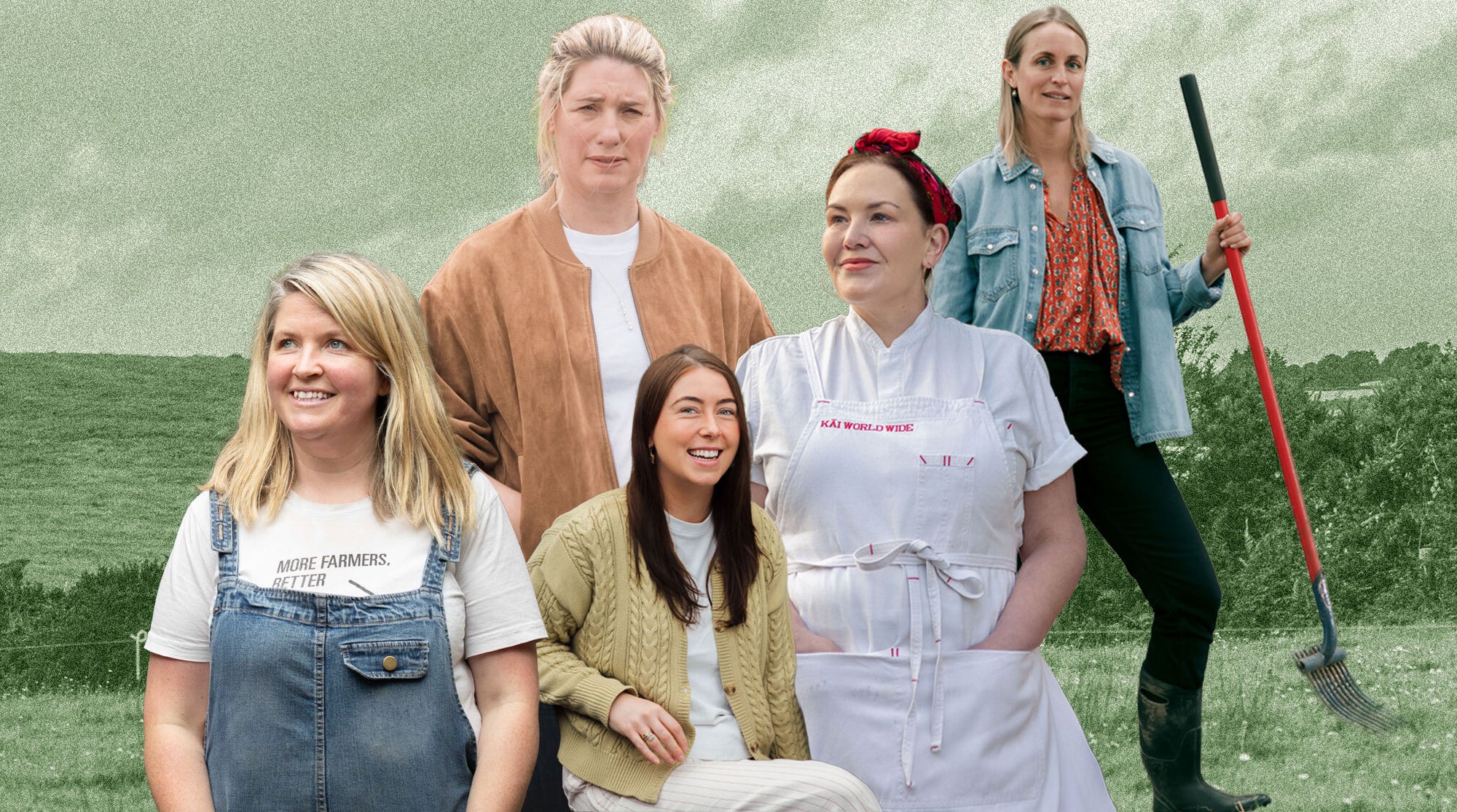
These days, the west still tests whoever stays. Most family farms are too small to support a living wage. The lifeline of subsidies and loans remains elusive for rural growers who prioritize quality and artistry over yield. With only 4 percent of farmers under the age of 35, the reins aren’t being passed down, and sons are still preferred over daughters. Yet a radical renewal is underway, led largely by women. From County Clare to County Mayo, heritage pig and cattle farmers, dairy farmers, cheesemakers, and entrepreneurial herbalists are rebuilding Irish food from the ground up: craft over volume, seasonality over yield, living soil over speed. At the center is Jess Murphy and her Galway restaurant Kai—where this work lands on her table—keeping small producers viable in an unforgiving system.
In a group chat Murphy started, these women share expertise and opportunities. In a brutal economic reality, they’re building something sturdier than any one purveyor could manage alone. “To survive,” she says, “we all have to survive.”


In the foothills of the Slieve Aughty mountains, the shop at Kylemore Farmhouse Cheese smells of tangy curd and sweet hay. Seamus, a brown pony, nudges the door open and slips inside. Teresa Roche smiles, waves him back, and presses a knife through a wheel of hard cheese.
Eleven years ago, after working as a nurse in Australia, Roche returned home to her family’s farm in Galway, only to find her parents barely making ends meet. “Small farms are closing all the time,” she says. “If we didn’t diversify our milk, we wouldn’t be farming in five years.” Determined to save the farm, Roche decided that the future was in cheese. “We had no skills or equipment and depended heavily on our neighbor, a cheesemaker,” she says.


After training in Switzerland, she committed to making long-aged Alpine-style cheeses—a rarity in a country flush with commercial cheddar. Each batch begins with pasteurized milk (inoculated with Swiss bacterial cultures) from the family’s closed herd of grass-fed pedigree Holstein Friesians. In the aging cave, the air is cool and faintly fungal. Wooden shelves hold wheels of cheese, rinds busy with microbes that ripen and protect. Roche washes and turns each wheel daily. “The Swiss are very strict, turning them eight times a day, but who has time for that?” she laughs.
“Cheese has returned a sense of pride to the farm,” says Roche, who also runs tours, guiding visitors through the process from herd to milk to wheel.


Jess Murphy sorts through a crate of spring vegetables—ramps, three-cornered leeks, sorrel. Her fingers working through the pile, she builds the day’s menu in her head, smiling at the rhubarb, still damp from the field. “Love how they pop up,” she says. “A burst of bright pink after the long winter.” Light falls through the glass roof, across stone walls and Kai’s close-set wooden tables.
Originally from New Zealand, Murphy started feeling stuck there after some time spent working abroad. “I needed to get back to Europe, I wasn’t learning,” she says. “Tourism Ireland ads were trying to relocate people to the west, and I said to my husband, Dave, ‘Can we go live there?’” And they did, moving to Galway’s Westend, where, in 2011, they opened their own restaurant.
Kai now holds Ireland’s only Michelin Green Star—recognition of culinary excellence and sustainable practices, which Murphy was following long before they were fashionable. “I cook with my heart, she says. “It’s the Kiwi, Māori, and Irish in me.”
In Māori, kai means both “food” and “to eat.” The concept is central to Murphy’s enterprise, whether in her kitchen, where her staff are teaching her to make Kabuli pulao and Ethiopian injera, or through her work with the United Nations High Commissioner for Refugees, documenting the culinary traditions of displaced people. “Food gives people their dignity back,” she says. “There are no borders with food.”
Murphy’s curiosity runs close to home, too. “I’m in a deep dive into Irish grains and legumes,” she says, “trying to create a circular economy with small local farmers, sourcing from them and encouraging collaboration.” The producers, many of them women excelling in traditionally male-dominated fields, are the backbone of Kai. “These women are total badasses,” Murphy says. “Without them, Kai wouldn’t be the same. You can feel the love and soul they put into the food—from land to sea, dairy to dirt.”


In a tiny wooden shed, Sinéad Moran tilts a chilled bottle, watching cream as thick as ketchup slide down the glass. Brown eggs sit beside a red cash tin and two glass-front fridges full of raw milk, cream, butter, and yogurt.
By sight, Moran can tell that the cream in her hand comes from cows grazing on clover and buttercups on Gleann Buí Farm. When she and her partner, Mick “MJ” McGrath, took over his family’s dairy, they started out working from a distance. She was obtaining a master’s degree in Dublin, studying the positive impact that reduced beef and dairy consumption can have on greenhouse gas emissions. “Then one day, MJ bought 17 heifers,” she says, laughing. “That put me in the deep end of farming for real.”


One day, MJ mentioned that he grew up drinking raw milk. “I said, ‘How did I not know that? And what’s raw milk?’” The question quickly became a plan. At first, the couple assumed the hardest part of starting a microdairy would be the build-out and navigating regulations. The real hurdle turned out to be earning the local market’s trust. Moran started a membership club, with customers collecting milk orders on the honor system. Five years later, she says, “Customers can tell from taste and texture which field their milk comes from.”
Out on a misty pasture, Moran introduces her heritage Shorthorns like the Spice Girls, each with a defining personality. “Nari’s the matriarch. Zoe, the queen—her mother was Highland. Rosie is constantly eavesdropping.” The breed, which was spared the push for industrial yield, is free to retain its natural character. “They’ve kept a kind of wisdom,” she says, plucking a small leafy plantain plant for proof. “See this? We call it a weed, but for them, it’s medicine. I saw one single-grazing it—they know.”


A steamy mound of compost rises in a barn in County Clare, fed by scraps collected throughout the year. “It has microorganisms from all over Ireland,” says Lúnasa Farm owner Cass McCarthy. Healthy soil underpins everything at Lúnasa—good pasture, strong animals, exceptional meat. Practicing Korean Natural Farming, McCarthy sets out boxes of cooked rice to catch native bacteria and fungi. Soon, fuzzy mycelium blankets the grains; mixed with brown sugar, this becomes a starter culture for compost. “It’s like rocket fuel,” she says, “feeding life back into the soil.”
The farm hums with the same earthy logic. On 35 acres, Cass and her husband, Nick, raise Oxford Sandy and Black pigs, a heritage breed that was nearly extinct 20 years ago. Under the McCarthys’ hands-off approach, the pigs forage freely and give birth in the woodlands. “It’s amazing to watch them break off branches to build their nests,” Cass says.


For Cass, ethical stewardship is more than a moral imperative—it’s also good business. Nick breaks down each animal himself, wasting nothing. “This and selling direct makes a small farm like ours viable,” Cass says. Offerings from their Clarecastle butchery satisfy a diverse community, from South Americans seeking asado cuts to Eastern Europeans “who remember the pork their grannies raised.”
Bone broth, tallow, and organ mince round out the selections. By the end of Nick’s work, only a bucket of trimmings remains—just enough for the cats.


Outside the windows of a former fish processing plant on the edge of Galway Bay, seaweed clings to the rocks. Sunlight slides across the floor of Óir Tonics as founder Edel Breslin steps forward, a steel bowl of purple Irish sea moss in her hands. “This is what it looks like before we sun-bleach it on grass,” she says.


While working at a health-food shop during the COVID-19 pandemic, Breslin noticed older women asking for clumps of dried seaweed to make curative concoctions. “It brought back memories of my granny talking about how awful those old tonics tasted,” she says. Carrageen, or Irish moss, has long been used to treat respiratory ailments during Ireland’s harsh coastal winters. Boiled with garlic, pungent herbs, and whiskey, the syrupy cures were infamous—bitter enough to make kids squirm.
Breslin began experimenting in her uncle’s restaurant after hours, testing carrageen elixir recipes and sharing the results with friends. “They’d say, ‘Could I get that off you again?’ The business grew naturally.” Murphy urged Breslin to take her project further, pointing her to a nearby university incubator program. Within two weeks of selling her wares at the farmers market, shops began calling. “We launched during flu season, which helped,” she says, smiling.
Drawing on her training as a chef and herbalist, Breslin now sells four therapeutic tonics. “The process is similar to beer-making,” she says. After washing the seaweed in spring water, she dries and heats it with turmeric and ginger, adds clementine peel, raw apple cider vinegar, and honey. Other organic ingredients include wild blueberries and Irish-grown lion’s mane mushrooms. Breslin’s small team bottles and labels every batch by hand, though she’s hoping to automate soon. The tonics sell out weekly. And as for Granny? “She says they taste lovely.”


