


Author Gary Shteyngart once wrote, “When I was young I lived in Berlin as most young people did back then. The parties were incredible and you could get trashed for ten euros. But the food sucked.”
He was only half-right. It’s not that there was no good food to be had, but this was, after all, a city cleaved in two and partially reduced to rubble in living memory. The vast abandoned spaces created in the ’90s after the Berlin Wall came down were fertile ground for techno and art; not so much for restaurants. Then in its rush towards reinvention, Berlin seemed hell-bent on erasing its gastronomic heritage the same way it razed Potsdamer Platz only to replace it with a mall.

By the time I moved there in 2014, the hauptstadt was a little less “poor but sexy,” as Berlin’s mayor famously put it in 2003, but it seemed unsure of what came next. Chain bakeries hawking limp croissants were edging out their mom-and-pop counterparts. Pan-Asian restaurants serving wan imitations of their source material abounded; overpriced brunch was having a moment; and food trucks committing various crimes against tacos were considered “sehr cool.”
But after more than a decade of reporting on food here, I’m happy to say it’s become one of my favorite places to eat—in large part because Berliners have embraced what was there all along. At its core, East and West, this has long been a city of immigrants and outsiders. With the largest Turkish population outside of Turkey, you could argue that the döner kebab (a magnificent thing when done well, but not in this guide since it deserves its own) is more Berlin’s official dish than the currywurst. There are also sizable Vietnamese, Lebanese, Palestinian, Israeli, West African, and Syrian diasporas. Not to mention every nationality with an EU passport is well-represented here.
Today, Berlin is home to chefs willing to take risks (where else would you find a two-Michelin-starred dessert restaurant?) and embrace the city’s multikulti identity. And while you’ll still occasionally find old-school dishes like calves’ liver, eisbein (cured and simmered pork knuckle), and königsberger klopse (meatballs in a creamy sauce) on menus (try Zur Letzen Instanz), the hottest tables in town are more likely to be serving hand-pulled noodles or hummus. Although I moved away from Berlin a few years ago, I go back often—this time, for the food.
Azzam
Sonnenallee 54
+49 30 60977541

After the Lebanese civil war broke out in 1975, more than 100,000 refugees fled via the East German Democratic Republic’s national airline and booked transit visas to West Berlin. Many settled down on Neukölln’s Sonnenallee, a street that has since become home to waves of new arrivals from the Middle East. It’s also one of the best places to eat in town. I come to the area for everything from Syrian knafeh at Konditorei Damaskus and Lebanese fatteh at City Chicken Breakfast.

For silky hummus and platters piled high with pickles and extra-crunchy falafel, Azzam is always the move. Mansour Azzam, known to many locals as Hajji, was born in a refugee camp in Lebanon and immigrated along with tens of thousands of other Palestinians in the ’90s. Today, Berlin is home to the largest Palestinian diaspora in Europe. Azzam himself looms large as a figure in these parts; he’s been quick to offer jobs, aid, and advice to Syrian refugees and other new arrivals to the neighborhood.
Barra
Okerstraße 2
+49 30 8186 0757

While the phrase “seasonal small plates and natural wines” usually makes me want to hit snooze, Barra does it better than just about anyone. For years, Berlin’s restaurant scene seemed split between imbiss-style fast food and fine dining menus with minimal middle ground. If you find yourself craving something a bit fancy but not stuffy, go ahead and snag any reservation here you can find (years in, it’s still a tough get).
The service is warm and unpretentious, the candlelit dining room and conversational buzz just so. And unlike other small-plates eateries, you’ll actually leave full. Chef Daniel Remers’ menu shifts constantly, but if you see any iteration of gnocchi, order it immediately. On my most recent visit, I especially loved the trout with blood orange and roe, a paint splatter of a dish that goes hard on acidity and brine.
Mausi
Walking from the Rathaus Neukölln U-Bahn station to Rixdorf feels like dropping into another era. The area was once part of an independent city founded by Bohemian Protestant refugees. Here, just steps from a shopping hall, you’ll find cobblestoned streets lined with ancient trees and historic buildings. On the main village square of Richardplatz, there’s a working iron forge with roots dating back to the 17th century.
You’ll also find this cozy spot, which somehow fits right in despite being a relative newcomer from 2025. Mausi exemplifies what a neighborhood restaurant should be: A last-minute walk-in table is almost always available; the vibes are always welcoming; and the vegetarian small plates are affordable and satisfying. I especially like the grüne Soße—Frankfurt’s herbaceous “green sauce” served here with crispy potatoes and hard-boiled egg. There may be more ambitious restaurants in Berlin, but it’s hard to imagine a nicer way to spend the evening than sipping a spritz on the garden patio here.
LIU 成都味道面馆 Nudelhaus
Kronenstraße 72
+49 178 668 4572

Liu Linqian, a Chengdu native, and her husband Bernhard Srokas, a German engineer, got their start selling Sichuan-style noodles to homesick Chinese expats via a WeChat group in 2017. The following year, they opened a lunch-only restaurant in a drab stretch of Berlin’s Mitte neighborhood otherwise frequented mostly by office workers. At the beginning, the German press warned that the noodles were so hot they’d make you cry. More than one TripAdvisor naysayer complained that the food was “zu scharf zu genießen” (too spicy to enjoy).
Luckily, Linquan ignored them all and refused to dial down the flavors to coddle unaccustomed palates. That the restaurant was a smash hit is a testament to how stupefyingly good the food is. I dream of the Shengjiao noodles, which come topped with beef, cilantro, and a lake of chile oil. It’s a textbook balance of má là flavors—there’s serious heat and intensity here but also a remarkable level of savoriness and nuance. Arrive early if you want to snag the limited-order tianshui noodles—the thick housemade strands, which are served cold, sport a satisfying QQ chew and a glossy, tongue-tingling sauce. The restaurant doesn’t take reservations, so just pull up a table in the panda-packed interior and get slurping.
Ari’s
The street view of Berlin’s Bauhaus buildings is often only the tip of the iceberg. Tucked away in the hinterhof, or back courtyard, of this old garage in the Kreuzberg district you’ll find what appears to be an American diner by way of Lima, complete with cherry-stained wood countertops and gleaming chrome. Arianna Plevisani, a Peruvian-Italian Berlin hospitality veteran, adds all sorts of clever twists to the formula—think ají amarillo and shoestring fries on a cheeseburger, or pickled mustard seeds and crunchy buckwheat on a buttermilk ranch wedge salad. I like to grab a seat at the bar on Saturdays, when the kitchen serves a mean ceviche special.
Adana Grillhaus
Audre-Lorde-Straße 77, 10997 Berlin, Germany
+49 30 612 7790

Berlin has no shortage of Turkish grillhouses, from the stately Pamfilya Restaurant to the more modern Fes, where diners grill their own lamb chops tableside à la Korean barbecue. But I would be remiss not to shout out this Kreuzberg OG, which has been serving up heaping plates of grilled meats and mezze for more than 30 years.
Absolutely everything is great here, but what really sets Adana Grillhaus apart is the quality of the lamb, most of which comes from the nearby state of Brandenburg. My go-to order is the adana kebab with yogurt, tomato sauce, and a generous pool of hot, spiced butter. Pro tip: Should you find yourself clubbing into the wee hours in the Friedrichshain neighborhood, the restaurant is open until 4 a.m. on Fridays and Saturdays.
While I tend to frequent the original Adana Grillhaus on Audre-Lorde-Strasse, there are several other locations these days, including a slightly swankier one on Kurfürstendamm, Berlin’s famed shopping boulevard. Since they’re not all under the same ownership, they have slightly different menus, but all are excellent.

Jemetisches Restaurant
Karl-Marx-Strasse 172
+49 30 9839 3579
I have this fantasy that one day I’ll bring together 40 of my dearest friends,and we’ll devour an entire lamb on Karl-Marx-Strasse. Until I can gather that critical mass, I’ll have to content myself with smaller offerings from the vast menu at Berlin’s first Yemeni restaurant (it now has a second location in Moabit). Order the fahsa, a sumptuously spiced lamb stew served with a wagon wheel-sized malawah flatbread, which arrives warm from the oven. A close second choice is the lamb mandy, a bone-in shank accompanied by a mountain of turmeric-tinged rice. The portions are almost cartoonishly generous, the tea is strong, and the ambiance is just right for a leisurely weekend lunch.
Malakeh
Potsdamer Strasse 153
+49 176 2216 0998

Malakeh Jazmati never set out to become a celebrity chef. After fleeing the Assad regime, she was helping provide aid at a Syrian refugee camp in Jordan when a TV producer approached her to star on a cooking show. By 2015, when she immigrated to Germany, along with her husband and nearly 1 million other Syrian refugees, she had already built up a name for herself—only to leave everything behind.

Since opening her eponymous restaurant in Schöneberg, Jazmati has become a star in her adopted homeland, publishing a German-language cookbook, appearing on television, and cooking for Angela Merkel. While Jazmati’s story is inspiring, it’s her superb cooking that has made Malakeh such a success. Dishes like the shish casserole, with a luscious, garlicky sauce and tender pieces of chicken under a sesame-dusted bread dome, and the fattet makdous, with layers of eggplant, well-spiced beef, pita crisps, yogurt, and pine nuts, are wonderfully rich and perfect for sharing.
Rocket + Basil
Lützowstr. 22
+49 178 3235089

When COVID lockdowns were in full swing, I used to walk or bike four kilometers to pick up sandwiches from this lovely café in Schöneberg. Thankfully, now I can order Xenia and Sophie von Oswald’s entire menu again. The sister duo, who were born in Hamburg to an Iranian mother and German father and spent some formative years in Australia, started Rocket + Basil as a food blog, then turned it into a catering company, and then, finally, a dreamy sit-down breakfast and lunch restaurant.

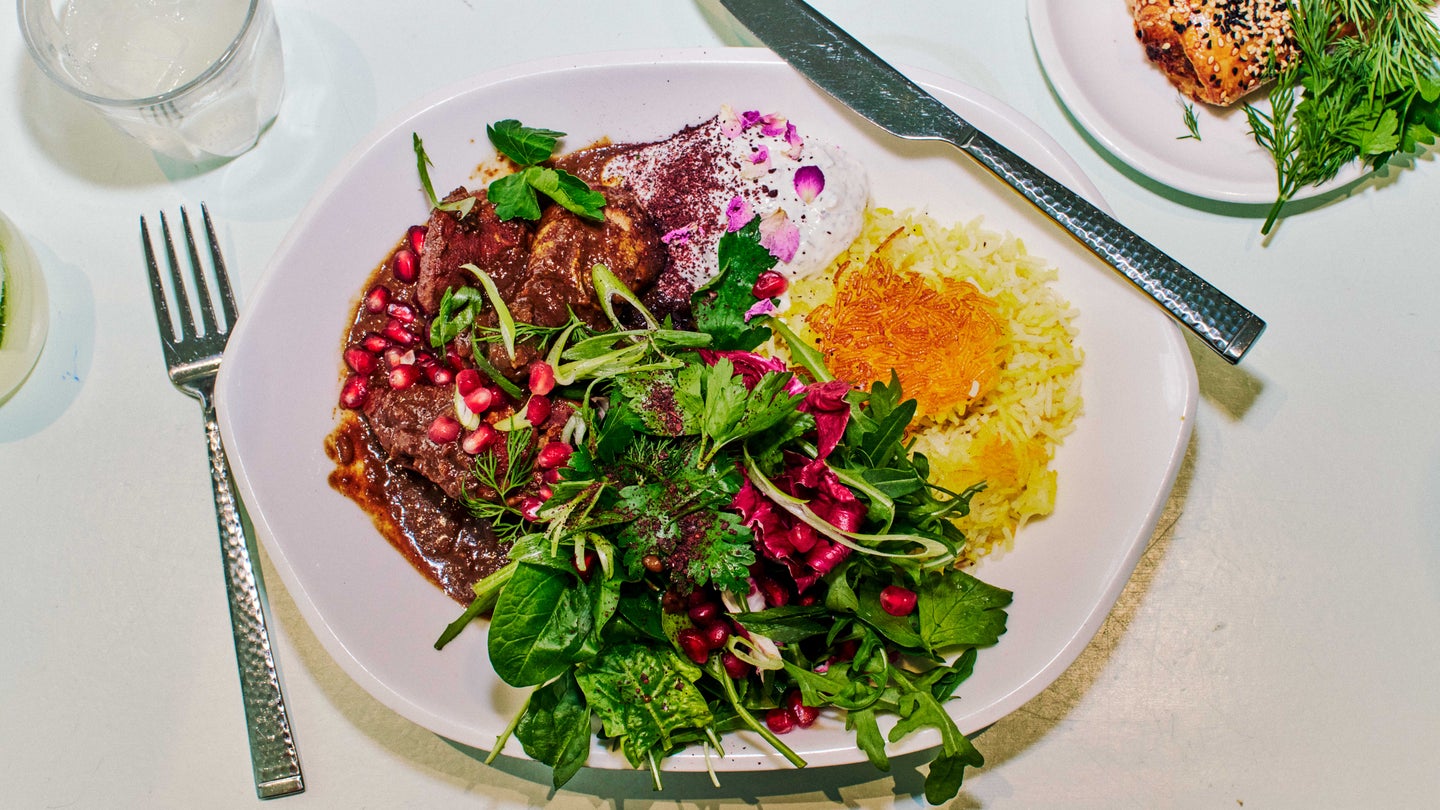
Dishes here go hard on texture—bushels of fresh herbs, speckles of pomegranate seeds, swooshes of yogurt, and handfuls of toasted hazelnuts abound. In a city where salads often feel like an afterthought, Rocket + Basil’s renditions with whole roasted cabbage wedges feel like a revelation. While the brunch fare gets most of the attention, it’s the saffron-perfumed tahdig with sweet-tangy apricot chicken and other Persian-influenced dishes that keep bringing me back.
Café Pilz
More than 10,000 Israelis have made a home in Berlin, thanks in large part to Germany’s right of return, which provides a path to citizenship for the descendants of Jewish people who fled the Holocaust. As a result, some of the most exciting restaurants to open in recent years—including the lovely Café Mugrabi— are serving shakshuka, hummus, and falafel.
I’m especially partial to chef Gefen Cohen’s exceedingly charming spot in Schillerkiez, where I often find myself after a bike ride in nearby Tempelhofer Feld. The roasted cabbage with hazelnut dukkah, hot eggplant with green tahini, and sumac-sprinkled bread salad are all essential orders. If you can, grab one of the few outdoor seats for excellent people-watching.
Otto
Oderberger Strasse 56
+49 30 5870 5176

Before Otto was a restaurant it was a garden. After stints around the world including Maaemo in Oslo, Koks on the Faroe Islands, and a food truck in Mexico City, Vadim Otto Ursus returned to his hometown of Berlin, where he started growing produce to pickle and ferment. At the tail end of 2019, he opened this 19-seat restaurant on a quiet street in the Prenzlauer-Berg district. While the cooking here nods to Ursus’ time spent in New Nordic kitchens, there’s nary a foam or gel in sight.

Dishes like a butterflied whole brook trout lashed with housemade garum or white asparagus cloaked with egg yolk and sprinkled with toasted hazelnuts feel simultaneously sophisticated and rustic. Unlike more militant locavore restaurants like Nobelhart & Schmutzig, you’ll find imported black pepper, vanilla, and citrus here, but Ursus uses regional ingredients wherever possible. In lieu of olives, you’ll find pickled, unripe gooseberries; instead of anchovies, there’s vendace, a tiny fish that thrives in Lake Stechlin north of the city, which the restaurant salts and ages for two years. The menu changes seasonally, although popular dishes such as the beets twice-cooked in sloeberry juice with labneh and browned butter make regular appearances.
Gazzo
Hobrechtstrasse 57
+49 30 9837 0104

From La Bionda, with its punk Italian energy and vinyl soundtrack, to Sanpietrino, a food truck and brick-and-mortar serving Roman-style pinsas (get the carbonara drizzled with raw egg yolk), Berlin has a serious pizza scene. Despite the many strong options, I find myself returning to Gazzo again and again. Part of that has nothing to do with the pizza—the marinated olives and the buffalo milk soft serve with olive oil, flaky salt, and crumbled shortbread cookies are the stuff of serious cravings.

But mostly, it’s the Neapolitan-adjacent pies, with their blistered corniciones and faint sourdough tang. From the buffalo mozzarella to the sausage to the wheat flour, everything that can be sourced locally here is—save for the barrel-aged anchovies from the Amalfi Coast, which you definitely want. Keep an eye out for owner Mikael Andersen’s seasonal specials, or opt for my standard order: the spicy salami with Padrón peppers and burrata, or the white pie with zucchini, feta, sliced lemons, and mozz.
The post 12 Berlin Restaurants That Offer So Much More Than Currywurst appeared first on Saveur.
