
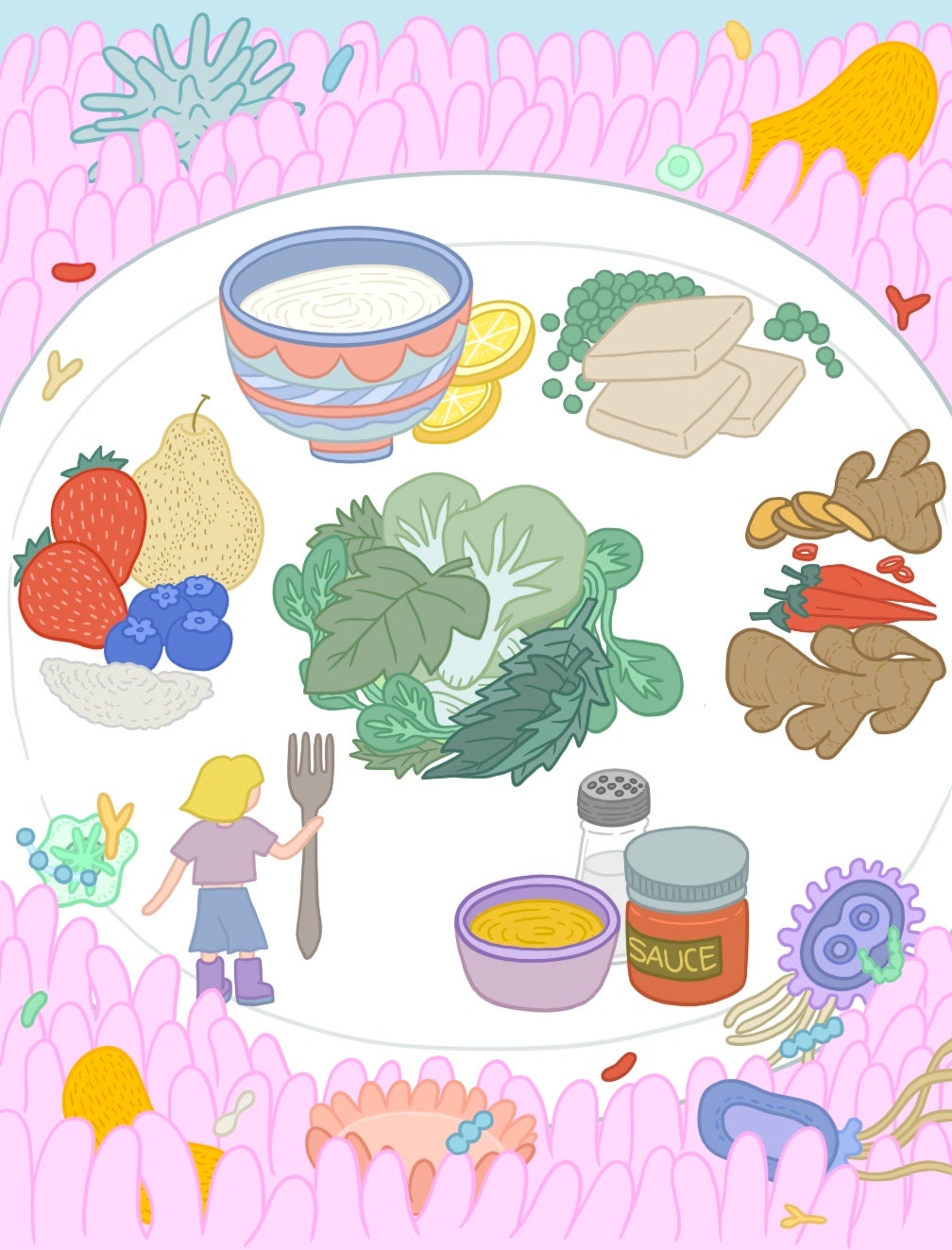

Welcome to Gut Check, our column dedicated to the complex, ever-evolving relationship between food and our bodies. Whether you’re curious about mindful eating or want to understand what makes picky eaters picky, read on and let award-winning journalist Betsy Andrews answer all your burning questions.
I am 15 pounds lighter than I was four months ago; my digestion has improved; and a chronic, low-level congestion has cleared. I feel better, I’m less stressed, and significantly, I am motivated to keep on a more healthful track. This is real transformation: While I had long wanted to lose weight and change my habits so that my gut felt better, I had been unable, or unwilling, to do so.
So how did this happen? First, I went to India on an Ayurvedic retreat. I had been invited to Ananda in the Himalayas for the launch of the wellness resort’s cookbook, The Healing Plate: Ayurvedic Recipes for Modern Living, based on unique principles of health and medicine that have been practiced in India for 5,000 years. Because I had come so far, I stayed for a weeklong treatment.
I eat, drink, and travel for a living, so it was no surprise that Dr. Naresh Perumbuduri, a senior Ayurvedic physician at Ananda, put me on a detox track. I was suffering, he explained, from high levels of ama—toxins from partially digested food that build up when your agni, or digestive fire, is weak. This, he claimed, was causing inflammation and irritability, and skewing my doshas, or energies. “You’re constantly traveling, constantly working. Your sleep is fluctuating,” Dr. Perumbuduri pointed out. “I don’t know how well you’re handling that occupational stress.” The very subjects of my occupation—food and booze—compounded my condition.
Ayurveda is a holistic and functional approach. It’s focused on preventing disease by establishing balance—within one’s self and with one’s environment—through diet, use of herbs, and many other practices and lifestyle choices. Dr. Perumbuduri prescribed me the whole nine yards: massages, meditation, hatha yoga, acupuncture, cupping, physical and emotional therapy, and a diet of warm water and grain or legume stews, conservatively seasoned and portioned.
After the delicious food that chef Diwaker Balodi’s team had prepared for the cookbook launch, my detox meals felt like a bummer. The intense schedule Dr. Perumbuduri put me on had me rushing from one treatment to the next—a situation that could threaten to actually increase my stress. Some of the practices seemed dubious; suffice to say the treatment in which I sucked hot smoke up my nose was not a favorite. It took me days to relax into the routine, but by the end of the week, sure enough, I felt less tense, lighter, and more grounded.
Then I got food poisoning from an in-flight meal on the way home. For more than a week, I couldn’t eat, so I dropped weight fast. When I saw my doctor, I discovered that the watermelon juice I had guzzled to combat dehydration had helped elevate my blood sugar. “You’re prediabetic,” she said. “Stop eating high-glycemic foods.” I dumped the juice. I had just finished working on a chocolate cookbook. Out went the featured ingredient. Out went refined sugar and simple carbs. And, if not out, then down went the alcohol consumption. I took the yoga and stretches I’d learned at Ananda and went back to the gym. My gut has stopped complaining.
As in all human stories, what happened to me was complex. Even if a week of Ayurvedic practice didn’t turn my entire life around, the retreat did spark a reset: After Dr. Perumbuduri encouraged me to pay attention to my well-being, I was able to turn food poisoning and scary blood work into something positive. Partly, this was just the experience of breaking from routine. Sometimes, when you get pulled out of your regular shtick and into something different, or even strange to you, it can help you look at your regular patterns, question them, and tweak them.
But my time on retreat also got me interested to learn more about Ayurveda. How could this ancient Indian philosophy be applied to life in the contemporary U.S.? Speaking with experts here and in India, I learned that Ayurveda is more than an ancient Indian medical philosophy. It’s also full of commonsense advice for improving gut health and overall well-being, no matter where you live.
Food Is Medicine
Though large-scale clinical trials on its methods are lacking, with the rise of integrative approaches, there’s been a marked increase in interest in Ayurveda in Western medical circles of late. Recent studies have demonstrated the helpfulness of Ayurvedic herbal preparations in improving issues associated with obesity and the efficacy of Ayurveda as a companion to conventional medicine for treating a host of chronic diseases, including gastrointestinal ones. As to eating, Ayurvedic nutritional therapy has been found to significantly benefit IBS patients. An Ayurvedic diet—high in fiber, polyphenols, and complex carbohydrates—has been shown to help regulate blood sugar levels in people with type 2 diabetes and to restore the diversity of gut microbiota, which can decrease the likelihood of GI-related diseases like colon cancer.
Ayurveda’s approach to diet is distinct from that of Western medicine. Though, recently, Western studies have been linking diet to gut health and gut health to overall health, even the American Medical Association admits that allopathic, or conventional, doctors lack tools to address the connections between food and medical issues. For years, Western doctors insisted there was no connection between food and medicine, notes Bhaswati Bhattacharya, clinical assistant professor of family medicine at Weill Cornell Medical College and author of Everyday Ayurveda: Daily Habits That Can Change Your Life. “If you just observe, you know that’s not true,” Dr. Bhattacharya says. “The enteric nervous system—the intestines, the gut—is bigger than the brain. We don’t give it the respect that it requires.”
Ayurveda, in contrast, starts with your gut and what you put in it. “It’s a wonderful complement to allopathic medicine, because allopathic doctors are not trained in nutrition, and you can trace almost every disease in Ayurveda back to gut issues,” says chef Divya Alter, owner of the Ayurvedic restaurant Divya’s Kitchen in Manhattan, and author of What to Eat for How You Feel and Joy of Balance: An Ayurvedic Guide to Cooking with Healing Ingredients. In Ayurvedic practice, Alter says, “when you’re not feeling well, the first thing to do is address the stomach, liver, gallbladder, and colon, because if you can restore the balance in the digestive tract, other symptoms disappear.”
Though an Ayurvedic diet is highly personalized, there are some general guidelines. Everyone, says Alter, should “eat freshly cooked, seasonal, whole, organic, local food as much as possible. Foods that grow in the same soil, air, water, and sunshine as you do will be the most medicinal and invigorating to support your vitality,” she claims. She suggests visiting a local farmers market at least once a week to see what’s available.
Seasonality is important because Ayurveda “works in opposites,” observes Erin Casperson, director of Massachusetts’ Kripalu School of Ayurveda. In summer, when we’re hot, we need cooling, hydrating foods. In the chill of winter, we need warming, nourishing foods. Of course, seasons vary across the planet, and we’re living in a global economy, where cuisines are diverse and foods are shipped from far-flung places. So not everything we eat will be local. But we should strive for a “healthy, seasonal routine,” says Dr. Bhattacharya. “We are animals on the earth, and we have to align with the cycles of the earth.”
The same goes for the cycle of the day. According to Ayurveda, we should eat our meals generally at the same time, minimize snacking, and not eat too late. “Our body doesn’t sleep well and digest at the same time. We feel like garbage the next day,” says Casperson. We need to give our digestive systems time to recuperate.
Just as we shouldn’t eat too often, we also shouldn’t eat too much. “In Ayurveda, we speak of the digestive fire, which is literally the fluids in the stomach and duodenum. If your fire is small, and you put too much on it, it will die,” says Alter. “A lot of people think you should feel heavy after a meal.” Ayurvedic principles would suggest “you should feel satisfied, not heavy,” she adds.
Portion control, meal scheduling, limiting certain foods—it can start to sound dull. But that’s where flavor comes to the rescue. Ayurveda classifies six tastes. “Sweet, sour, and salty are nourishing and grounding. Carbohydrates, proteins, and most fats fall under these,” explains Ananda’s chef Balodi. “Bitter, pungent, and astringent tastes are related to cleansing and detoxifying. Most of the minerals, vitamins, antioxidants, and phytonutrients in your meals are coming from those tastes.” (The Healing Plate recognizes umami, too.) According to Ayurveda, taste affects the balance of the doshas in our body and can either bring them into harmony or throw them out of whack.
It’s also the basis of pleasure. “Food is delicious, let’s be real,” says Casperson. Ayurvedic cooking provides an opportunity to play with your spices. “I look at my spice cabinet as a medicine cabinet,” she says. “Spices promote a diverse gut biome.” Black pepper, for instance, makes nutrients more available, as do cilantro, basil, and parsley. And Casperson suggests making pots of CCF (cumin, coriander, and fennel tea) by dropping a quarter teaspoon of each ground spice into a quart of boiling water and sipping it a few times a day. “It helps with decreasing bloating and gas, and smoothes and supports your digestive fire,” she says. And it’s darned tasty.
The Body Is an Ecosystem
“Ayurveda goes way beyond how food tastes on the tongue,” says Alter. It looks at the impacts those foods will have in your body after you’ve ingested them, many of which are specific to each individual.
“The body is an ecosystem,” as Dr. Perumbuduri told me. According to Ayurvedic philosophy, our bodies are composed of three doshas: vata, pitta, and kapha. (Though it’s been little studied from a Western scientific perspective, there is some evidence that the doshas have a genetic basis.) “Every physiological function is governed by these, and every individual is composed of them, but in various proportions. One will be predominant,” Dr. Perumbuduri told me. The doshas map onto the elements. High-strung, energetic vata is made of air and space; slow and steady kapha is earth and water; and pitta (which is dominant for me) mixes fire with some water. Pitta people, I’m told, are goal-oriented multitaskers, motivated by stress and prone to irritability and inflammation. According to Dr. Perumbuduri, to balance my digestion, alleviate my stress, and help restore my equilibrium, I needed a good rest and a diet that avoided the fermented, acidic, and spicy foods that inflame my agni.
Cooking methods can also balance out the doshas when your system feels wonky. “Vata is dry and cold. Vata people benefit from moist, grounding preparations, like braising and stewing. Kapha, with their slow metabolism, need dry, high heat. Think of roasting, grilling, broiling,” chef Balodi explained. “Pitta, which is already heated and acidic, needs gentle methods: poaching, boiling, steaming.” Nothing spicy, nothing grilled—no wonder my meal plan at Ananda seemed so convalescent. But apparently that’s what I needed to soothe my overheated system.
“In Ayurveda, detoxification is a process that supports the body,” Balodi says. “Our kidney, colon, and sweat glands are detoxifying minute to minute. Our digestion is converting food into energy. But if a lot of our energy is going into digesting, the second aspect of food, which is repair and building, will have less energy available for it. So detoxifying foods are easy on the system.” In my case, apparently, stress, a poor diet, and bad lifestyle choices had led to a buildup of toxins. I needed to stop what I was doing, scale back to a simple diet of detoxifying foods, and flush my system of those toxins to restore the natural balance of my bodily functions.
Ayurveda also suggests that the foods we eat should balance out the dosha’s seasonal nature. In the winter, as we nourish ourselves with heavy foods, kapha accumulates as mucus. In spring, to rid ourselves of all that, we should detox with light, stimulating foods made with spices like black pepper, ginger, and turmeric “that cut the heaviness,” says Balodi. In summer, the pitta in everyone increases, and so we don’t aggravate it, we need cooling, hydrating foods. In autumn, drier, cooler vata comes on: Grounding curries; boiled, stewed, and braised foods; and sweet, salty, and sour flavors pacify it.
But despite the seasonal cycles, no one’s doshas are a given. “They constantly fluctuate,” Alter explains, “so you have to go by what dosha is happening now. Choose the qualities of your food to be opposite of the qualities that you feel.” If you are overheated, don’t eat chiles; choose cucumbers, coconut, leafy greens. “They lower the heat, and your Pitta will feel happy.”
Get to Know Yourself
Ayurveda is not just a matter of what you eat; it’s how you eat. “If you’re distracted, the brain may not send all its signals to the digestive process,” says Alter. Walking, working, even talking while you’re eating diminishes the body’s intelligence to heal itself. “A simple mindful practice is to eat in silence,” she suggests. Look at your food. Smell it, so that your brain sends signals to your digestion about its composition: ‘It smells like cauliflower. Here’s the enzyme you need.’ Chew slowly and thoroughly, so that your stomach does not have to do all the work of breaking down the food.
“The root of Ayurveda is an awareness practice,” says Casperson. “There’s real medicine in slowness.” Ayurvedic practitioners like her say we should give ourselves time to pay attention. That goes not just for eating, but for all our actions: “It’s not just how you digest your food but how you’re digesting your life,” she notes.
Ample sleep, gentle exercise, sensory pleasures, emotional healing—they’re all part of the Ayurvedic approach. “Ayurveda is 60 percent about digestive fire and 40 percent about mental fire. Your mind is part of your body,” Dr. Bhattacharya says.
In the midst of a busy life, Ayurveda can sound like a lot to take on. But you just have to start simply, Alter says. There are Ayurvedic practices the professionals at Ananda would have liked me to adopt that I won’t. I’m not using the copper scraper that allegedly disinfects my tongue. I’m not snorting medicated oil up my nose, even if it’s supposed to keep me safe from air-borne germs. And, as lovely as they sound, I most likely won’t get the weekly massages that Dr. Perumbuduri suggested to relieve my stress. There are also things I will not entirely give up, like ice water, of which I am a devotee, even though Ayurvedic experts say it seizes up your insides. Ayurveda isn’t keen on raw vegetables, either, since they’re harder to digest, but I’m not bailing on salads. And the topic of my next book? Hot sauce. (Pray for my agni.)
But I can be more careful. I can watch what’s on my plate in all those restaurants I go to and pay attention to how it feels in my body. I can cook seasonally. I can eat slowly, enjoying my food more and shoveling it in less. Afterward, I might sit there for a bit or go for a little walk. I’m not sure which. While Dr. Perumbuduri said to walk for 15 minutes after eating to get the digestive juices flowing, Alter, in one of her books, describes a practice in ashram of lying on her left side for 20 minutes after eating. But I’ll figure it out. The point is, I’ll tune in to what my digestion needs, because caring for my digestion is caring for myself. And then I will have a good night’s sleep and get ready for what’s to come, because tomorrow, with any luck, I will wake up again, an animal on this earth, aligning with its cycles.
The post What Ayurveda Taught Me About Mindful Eating appeared first on Saveur.
